
Printing dates back as far as 3000 BCE. Being the print geek I am, I find the history of printing very interesting, especially the different forms of print and how they came to be.
But for our purposes, I’m starting in 1439 with the guy we all know: Gutenberg.
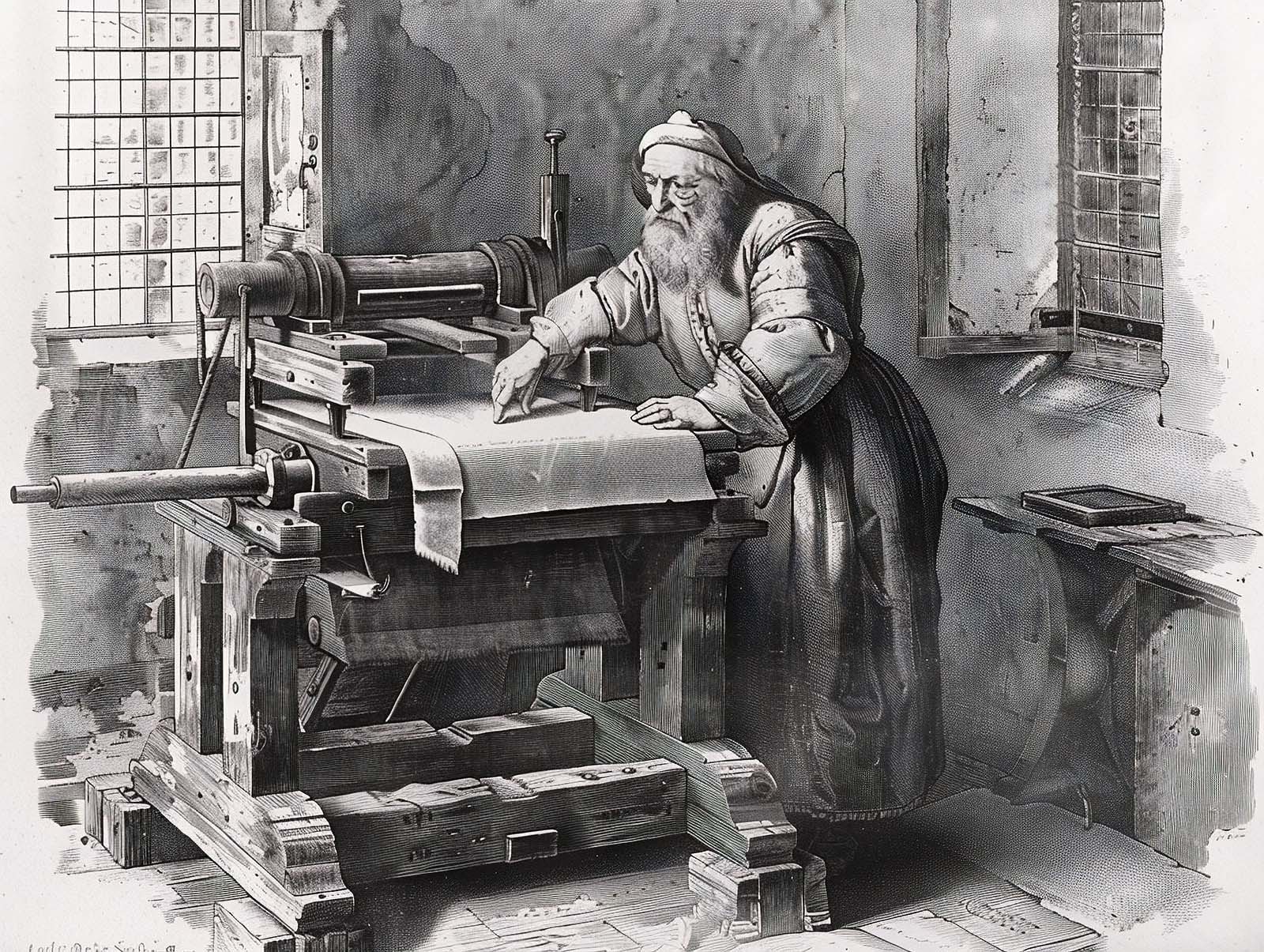
Johannes Gutenberg invented the printing press, an invention that improved upon movable type printing and revolutionized communications and book printing. The printing press is sometimes noted as the most important invention of our time.
Within just a decade, the age of printing began. Along with the invention of the printing press, Gutenberg, once a professional goldsmith, invented metal type pieces leading to typography and fonts. He is also credited with introducing oil-based ink, improving the durability of the pages. This process was known as letterpress printing and was widely used until the 19th century when offset printing became prevalent.
Printing in America started in 1638 when The Reverend Jose Glover endeavored to bring the first printing press to the American colonies. Unfortunately, he did not survive the voyage. Elizabeth Harris Glover, his widow, completed the mission and established the printing house, later known as The Cambridge Press. America’s first print shop!
Technological advances continued throughout the next three centuries. During this time, lithography was born. Simply, lithography is a method for printing on a smooth surface using a plate. Lithography encompasses several different print methods, including offset, which was introduced in the 1870s.

Offset printing was the mainstay of the commercial print industry until the early 21st century. Digital printing was introduced in the late 1980s and was primarily used for small-scale niche applications. The first digital press was invented in 1993. By 2010, as technology flourished, digital printing had become one of the most widely used printing processes worldwide.
While digital is the most widely adopted form of printing, it is still misunderstood. Printing is not copying. While copying produces pictures, all printing methods – including digital – produce individual quality images. Digital printing is a less complicated process than offset printing, but it is still founded on the principles of printing and uses a great deal of pre-press knowledge to produce a quality result.
Offset printing still holds a significant share of the print market and is known for its efficiency in large-scale projects and its ability to get metallic inks and specific Pantone colors to print correctly. In recent years, letterpress printing has seen a resurgence, along with the demand for embossing and engraving, and is most notably used for invitations and personal stationery.
Whatever the scope of your project — large or small, commercial or personal — visit your local printer to get the best advice on how to turn your project printed for a result you will be proud of.